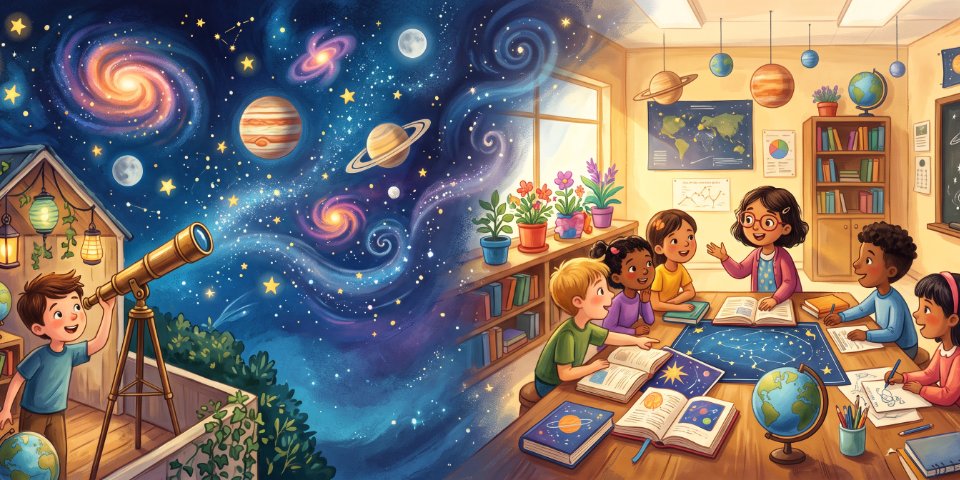
Eddie loved the night-time. When the sun went down, he would go out to his little observatory in the garden and point his telescope up at the sky. When he peered through it, he felt as if he was exploring the universe!
First, he focused on the moon, covered with craters. Then, he looked at Jupiter and Saturn. The huge gas giants looked like Christmas decorations hanging in the darkness of space!
Beyond that were the bright and distant stars. Eddie knew them by name… There was Polaris the pole star, and Vega, Capella, Rigel and Sirius, too! Did they have planets of their own? Eddie kept track of their positions every night and recorded them in his astronomy notebook.
But the things that really fascinated Eddie lay beyond those stars. In the depths of space, he could see swirls of light. They were galaxies, which contained millions upon millions of stars. Eddie wrote down their positions every night, too. But when the boy compared the positions of those galaxies, he noticed something strange: lots of them were moving away from Earth! Who could he tell about this?
The walls of the classroom were decorated with pictures of stars, planets and colourful nebulas. A banner reading ‘SCHOOL STARGAZERS’ SOCIETY’ was pinned on the board.
Fred dropped a big book on the table to get attention. The other members of the club stopped chatting and looked at him.
“I call the first meeting of the term to order! I hope you’ve all had fun observing the stars over the holidays. Now, what fascinating things have you discovered?”
Georgia shyly put up her hand. She was new to the club.
“I was observing the stars and had this interesting idea about the universe. What if it was created by something like a huge explosion at the beginning of time?”
Other members burst out laughing.
“That sounds silly!” chuckled little Albert. He never combed his hair and liked practical jokes, but he was very clever. “I think the universe has always been here and doesn’t change much. Simple!”
Fred nodded wisely. “Yes, that’s much more likely!”
Georgia blushed and adjusted her glasses. She felt foolish for telling the others about her idea.
When the meeting was over, Eddie went up to Georgia.
“I don’t think your idea was silly. Come to my house this evening—I’ve got something to show you!”
They had fish and chips for dinner, and when it was dark enough, they went out to Eddie’s observatory in the garden shed.
“Take a look at this!” the boy said, adjusting his telescope. “It’s focused on the Whirlpool Galaxy—it’s many light years away from us!”
Georgia looked through the eyepiece and adjusted the lenses. There it was, a swirl of stars in the blackness of deep space.
“That’s interesting, but why are you showing me this?” said Georgia.
Eddie grinned. “I’ve been tracking the Whirlpool Galaxy for months. You might be interested in what I’ve discovered!”
He pulled out his notebook. “It’s moving away from us! And do you know what I found when I tracked other galaxies as well?”
Georgia answered hesitantly. “Are they moving away, too?”
“Most of them are, yes! It’s as if they are being thrown away from each other by some huge event billions of years ago. I think your theory might be right, but we need a catchy name for it…”
The two kids spent all night comparing their ideas and calculating where the galaxies might be going.
At the next meeting of the Stargazers’ Society, Georgia and Eddie gave a presentation about their discoveries.
“As my data shows, lots of galaxies are moving away from us—it’s as if they were all created by some event in the past, as Georgia said!” Eddie announced to the group.
Georgia sketched out a diagram on the whiteboard, showing galaxies flying away through space.
The others clapped. “Very impressive!” Albert said as he patted Georgia on the back.
“We still need a catchy name for this idea, though!” Georgia said.
Fred wasn’t convinced by their presentation. “I still don’t think this ‘Big Bang Theory’ of yours will catch on!” he said with a frown.
“Thanks, that’s the perfect name!” Eddie laughed as he wrote it on the board in big letters.
They all looked at it in wonder.
“Who wants to see where the galaxies are going tonight?” Eddie asked his friends.
| US Phonetic | Simple Definition | معنی فارسی | |
| Observatory | /əbˈzɜːr.və.tɔːr.i/ | A building equipped for looking at the stars and planets | رصدخانه |
| Crater | /ˈkreɪ.t̬ɚ/ | A large round hole in the ground or moon made by an explosion or impact | دهانه آتشفشانی / گودال شهابسنگی |
| Gas giant | /ˈɡæs ˌdʒaɪ.ənt/ | A very large planet composed mainly of gases (like Jupiter) | سیاره غول گازی |
| Astronomy | /əˈstrɑː.nə.mi/ | The scientific study of stars, planets, and space | نجوم / ستارهشناسی |
| Fascinate | /ˈfæs.ən.eɪt/ | To interest or attract someone very strongly | مجذوب کردن / شیفته ساختن |
| Swirl | /swɜːrl/ | A twisting or curling shape or movement | چرخش / پیچوتاب مارپیچی |
| Galaxy | /ˈɡæl.ək.si/ | A massive system of billions of stars, dust, and gas | کهکشان |
| Nebula | /ˈneb.jə.lə/ | A giant cloud of dust and gas in space | سحابی |
| Stargazer | /ˈstɑːrˌɡeɪ.zɚ/ | A person who observes the stars | رصدکننده ستارگان / اختربین |
| Hesitantly | /ˈhez.ə.t̬ənt.li/ | Doing something in a slow, unsure, or reluctant way | با تردید و دودلی |
| Catchy | /ˈkætʃ.i/ | Pleasing, memorable, and easy to remember | جذاب و گیرا / زود در یاد بماند |
| Calculate | /ˈkæl.kjə.leɪt/ | To find an answer using mathematics or reasoning | محاسبه کردن / حساب کردن |
| Diagram | /ˈdaɪ.ə.ɡræm/ | A simple drawing showing the parts or operation of something | نمودار / طرح ترسیمی |
| Convinced | /kənˈvɪnst/ | Completely certain that something is true | قانعشده / مطمئن |
| Catch on | /kætʃ ɑːn/ | To become popular or widely accepted | جا افتادن / رواج یافتن |
دو نکته گرامری کاربردی و مهم از دل متن داستان:
۱. ساختار فرضی و غیرواقعی با As if + گذشته ساده (Unreal Comparison)
در متن جملهای آمده است:
“When he peered through it, he felt as if he was exploring the universe!”
و در جای دیگر:
“...it’s as if they were all created by some event in the past...”
نکته: وقتی از
as ifیاas thoughبرای بیان یک موقعیت غیرواقعی، فرضی یا تشبیهی استفاده میکنیم، ساختار فعل بعد از آن معمولاً یک زمان به عقب میرود (استفاده از زمان گذشته برای بیان حال یا تشبیه خیالی).کاربرد رسمی در برابر محاوره: در انگلیسی نوشتاری و بسیار رسمی، برای تمام ضمایر از فعل were استفاده میشود (مانند: he felt as if he were exploring...)، اما در انگلیسی مدرن و عامیانه روزمره (مانند این متن داستانی)، آوردن was برای فاعلهای مفرد (he / she / it) کاملاً رایج است.
۲. مجهول حال استمراری (Present Continuous Passive)
در متن جملهای آمده است:
“It’s as if they are being thrown away from each other...”
ساختار:
{Subject} + \{am/is/are} + {being} + {Past Participle (V3)}نکته: این ساختار زمانی به کار میرود که میخواهیم نشان دهیم کاری همین الان و در لحظه صحبت روی فاعل (مفعولِ عمل) در حال انجام است، بدون اینکه تأکید اصلی روی انجامدهنده کار باشد.
تحلیل در متن: فعل throw به معنی پرتاب کردن است؛ اما در اینجا کهکشانها چیزی را پرتاب نمیکنند، بلکه خودشان در حال پرتاب شدن / دور رانده شدن هستند. به همین دلیل ترکیب
are being thrownانتخاب شده است.